
Unless your house or car stays consistently above 70 degrees Fahrenheit with humidity steadily above 65 percent, a humidor is the only way to preserve cigars successfully at home.
Table Of Contents
−- Why Is It Necessary to Keep Cigars in a Humidor?
- What Exactly Is Cigar Humidification?
- What Is the Ideal Humidity?
- What Happens If My Humidor Has Excessive Humidity?
- What Happens If My Humidor Has Low Humidity?
- What Causes a Humidor to Lose Humidity?
- Cigar Humidifier Types Compared
- How to Season a New Humidor
- Hygrometer Calibration
- Which Type of Cigar Humidifier Should You Choose?

Too much humidity causes problems too, since mold will grow. That’s why there are various types of humidifiers made to keep a humidor at a constant humidity.
They vary in ease of use, accuracy, and price. Most can add humidity to a dry humidor, but they aren’t dehumidifiers, so they can’t bring humidity down in a humid climate. A few can.
I also have an article listing the best humidifiers for your humidor. This one focuses on the types and their advantages, so head to that article if you just want product picks.
Key takeaways:
- Aim for 62–74% humidity at no more than 74°F. Many collectors target 70% and 70°F.
- Disposable packs like Boveda are the easiest way to get started.
- Electronic humidifiers cost the most but suit large humidors.
- Season a new humidor first, and check humidity with at least two calibrated hygrometers.
Why Is It Necessary to Keep Cigars in a Humidor?
Cigar tobacco is grown and rolled in places like Cuba and the Dominican Republic. The temperature and humidity there are very different from places like the United Kingdom.
A humidor keeps cigars at the ideal humidity for smoking, wherever you live. Here’s what happens without one:
- Too humid: the cigar turns soggy. It becomes hard to draw smoke through, and the burn suffers, causing tunneling and excess smoke.
- Too dry: the cigar loses its flavorful oils and burns poorly, smoking too quickly and too hot.
What Exactly Is Cigar Humidification?
Humidifying your humidor is a critical piece of the puzzle that you can’t overlook. Keeping your cigars at the right humidity level helps them mature and improve in flavor.
Like wine, cigars improve with age, but only under the right conditions. Some Cuban cigar connoisseurs let their cigars mature for at least 3–5 years before smoking them.
Track it with a hygrometer
A hygrometer lets you keep a close eye on the humidity around your stored cigars. It tells you whether your humidification is working properly and holding the right level.
If you haven’t read our guide on hygrometers yet, we strongly recommend it.
Cigar collectors typically aim for 70 percent humidity and 70 degrees Fahrenheit. Some prefer to go a little lower, to 65 percent, particularly with Cuban cigars.
What Is the Ideal Humidity?
Opinions differ. Some cigar fans keep humidity as low as 62 percent, while others think 72 to 74 percent is ideal.
The right number depends on your humidor, how many cigars you’re storing, and even the type of cigars.
- Humidity: 62 to 74 percent
- Temperature: 74 degrees Fahrenheit maximum
- Tools: a digital thermometer and hygrometer, so you can adjust temperature and humidity inside the humidor
Even the greatest cigar humidors can have humidity swings from time to time.
Cigars should be kept in conditions similar to where the tobacco was grown, and a humidor is the ideal option. It has to be fitted with a humidifier, though. Otherwise it’s just a plain wooden box.
Problems can still develop even when you store cigars correctly. Several things affect humidor humidity, including the humidity in your home.
What Happens If My Humidor Has Excessive Humidity?
Humidity of 70–75 percent combined with a temperature of 65 degrees Fahrenheit or above can lead to major mold problems.
Collectors often assume they’re seeing harmless cigar plume. In these conditions, though, you have a humidity problem. Learn the difference between cigar mold and plume so you can check your collection.
What Happens If My Humidor Has Low Humidity?
You risk drying out the tobacco if you store cigars in a humidor with humidity below 62 percent. The cigar will taste harsh and may burn too hot.
I can’t overstate how terrible a dried-out cigar tastes. It’s like smoking rolled-up cardboard.
Signs your humidity is too low:
- Wrappers peeling off
- Flaky wrappers
- Brittle cigars
What Causes a Humidor to Lose Humidity?
Your humidor is empty when you first set it up. As soon as you add cigars, they start pulling moisture from the air inside the box, and humidity gradually drops.
How to deal with it:
- Refresh the humidifier: top it up a few days after adding cigars.
- Add cigars gradually: a couple at a time rather than a dozen at once.
- Close the lid promptly: leaving it open too long lets humidity escape.
Cigar Humidifier Types Compared
Here’s how the main types compare at a glance. Details on each follow below.
| Type | Cost | Effort | Humidity control |
|---|---|---|---|
| Sponge + distilled water | Cheap | High: constant refilling and monitoring | None; trial and error |
| Propylene glycol solution | Relatively cheap | Medium; liquid can spill | Set by the mix ratio |
| Gel | Varies by brand | Low; no spills | Premixed |
| Disposable packs | Higher | Lowest | Fixed level (e.g. 65/69/72%) |
| Beads or crystals | Varies by brand | Low; refillable many times | Fixed level (e.g. 60/65/70%) |
| Electronic | Most expensive (some $100+) | Refill the water tank | Adjustable |
Distilled water and sponge humidifiers
These are the simplest humidifiers, often built into small travel humidors. A sponge or other absorbent material is dampened with distilled water.
Advantages
- Cheap.
- Small and discreet, often built into the humidor cover or case.
Disadvantages
- No real humidity control: the level depends on how much water you use, so some trial and error is required.
- Constant refilling.
- Constant monitoring with a hygrometer.

Propylene glycol solution
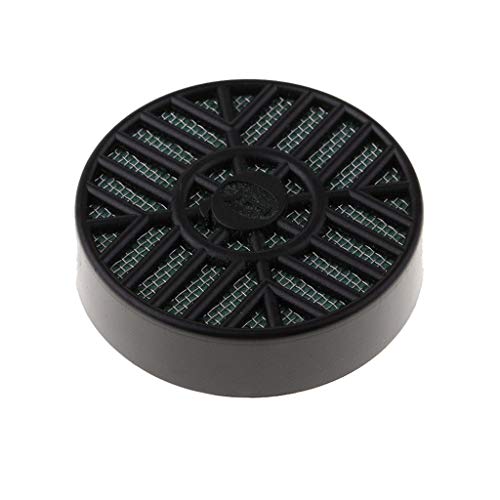
A mix of propylene glycol and water can be used instead of plain distilled water. It gives you more automatic control of the humidity level.
Advantages
- Relatively cheap.
- Adjustable: you control the humidity level by changing how much water you mix in.
- Premixed option: Madelaine sells propylene glycol and water premixed 50/50 and claims it will hold humidity at 70% to 75%.

Gel humidifiers
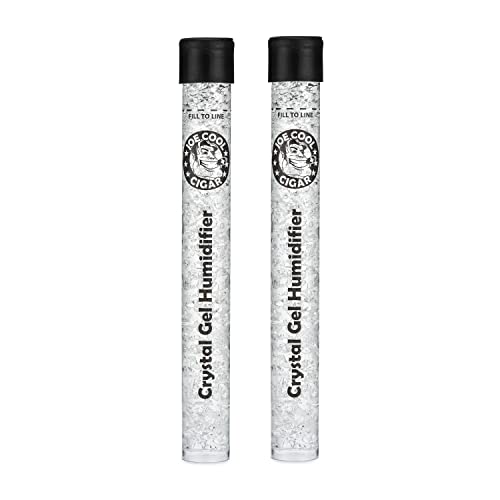
Gels work like propylene glycol but are easier to handle. They come premixed and aren’t liquid, so they don’t spill.
They come in a small jar, and you place the opened jar in the humidor. Brands include Humi-care and Ci-Gel.
Advantages
- Easy to use.
- Usually refillable a few times with distilled water.
- No spilled water.

Disposable humidifier packs
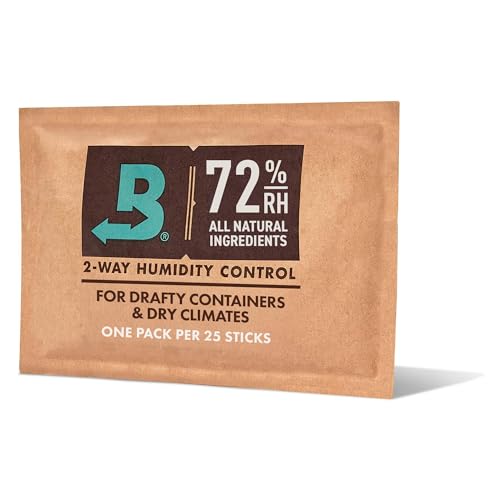
These are prepackaged gel or other materials. They cost more but are easier to use.
Some come in cigar-sized tubes that fit into any humidor, including small travel caddies. Examples include:
- Boveda: available in 65%, 69%, or 72% humidity. Boveda claims its packs both humidify and dehumidify, bringing down moisture that’s too high.
- Humid-EZE
- HumidiTube
Advantages
- Most aren’t damp, so cigars can touch them in storage.
- Easy to use.
- No spilled water.
Bead or crystal humidifiers
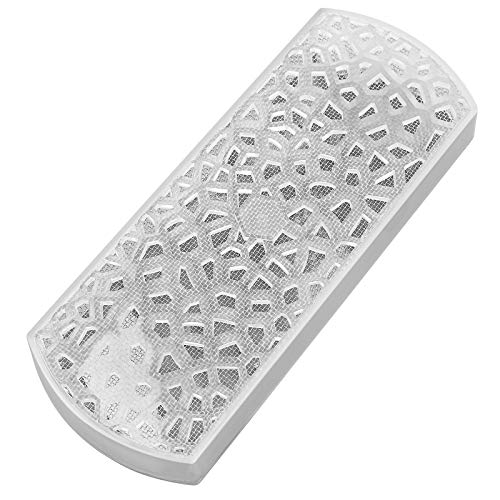
You spray distilled water onto the beads or crystals (the crystals soften into a gel). Then you place them in the humidor, usually in a small plastic container with holes.
- Heartfelt Humidity Beads: come in 60%, 65%, and 70% options, stored in a flat disc case.
- DryMistat: sells its crystals in a cigar-shaped tube.
- Xikar: sells its crystals in a small jar, like gel humidifiers.
Advantages
- Some manufacturers claim they can both humidify dry air and dehumidify air that’s too moist.
- Most aren’t damp, so cigars can touch them in storage.
- Can be refilled many times.
- No spilled water.
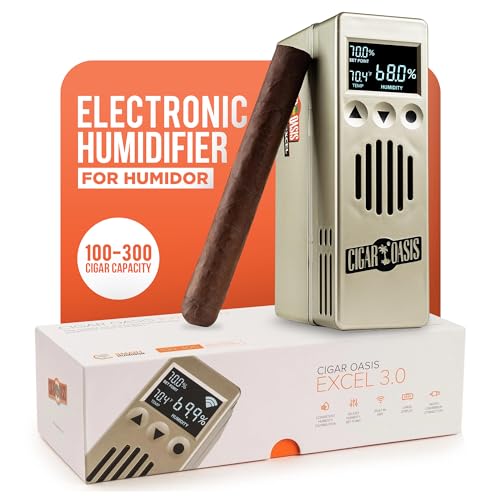
Electronic humidor humidifiers
Electronic humidifiers are the most expensive type, with some costing over $100. They run off mains AC power.
- How they work: an electric fan, an electronic humidistat that controls the fan automatically, and a refillable tank of distilled water.
- Hydra and Cigar Oasis: have a thin ribbon power cord designed to squeeze between the lid and body of the humidor.
- Cigar Oasis: can also run on AA batteries.
Advantages
- Suitable for large humidors. Some are designed to humidify as many as 1,000 cigars.
- You can set different humidity levels.
How to Season a New Humidor
A new humidor must be slowly dampened over a few days or weeks before you put a regular humidifier inside.
For convenience, Boveda sells “One Step Seasoning” packets.
Hygrometer Calibration
You need to confirm your humidifier is holding the right humidity, and that takes an accurate hygrometer.
Hygrometers are notoriously inaccurate. Both analog and digital models need to be calibrated periodically.
It’s a good idea to always use at least two calibrated hygrometers in case one misbehaves.
Check out my article if you want to buy the best hygrometer for your humidor.
Which Type of Cigar Humidifier Should You Choose?
Different people report different experiences with the same type of humidifier. That can come down to:
- Climate
- Usage, meaning how often the humidor is opened
- How absorbent the humidor is
- The number of cigars inside
Reading a few humidor humidifier user reviews is the best way to learn from other people’s experiences.
My recommendation: start with one of the prepackaged disposable humidifiers. They offer a good balance of low cost and ease of use.
For long-term use, it’s worth experimenting with a reusable option. Getting the right humidor matters too.

jay
Self proclaimed cigar expert. I've been smoking since 2010. I've practically lived at a cigar lounge from 10am to 10pm and trying every new cigar that came out for years.